Marcelino Sanz de Sautuola scientifically discovers the deposit during his prehistoric surveys in the then province of Santander.
A cave with a long bibliography
Eighty thousand years, one karst
From Sautuola in 1878 to the 1997 frieze and the 2026 excavations: how the Cave of El Pendo became a reference site for the Iberian Palaeolithic.
Hermilio Alcalde del Río finds engravings in the rear passage, including a bird, usually placed in the Lower Magdalenian.
Jesús Carballo coordinates new excavations, exposes the occupation sequence and recovers outstanding portable art, among it decorated perforated batons.
Julio Martínez Santa-Olalla leads an international team. El Pendo hosts field-archaeology courses; André and Arlette Leroi-Gourhan work at the site. Results wait years to be published.
Joaquín González Echegaray publishes the monograph on the 1953–1957 excavations.
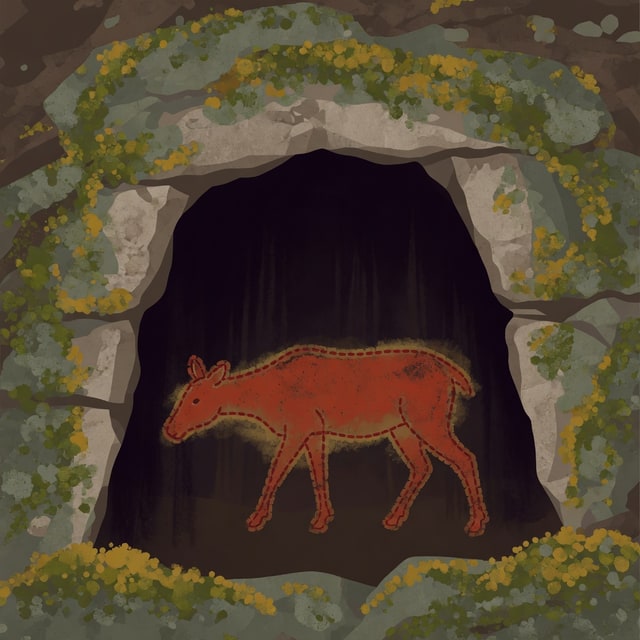
Ramón Montes and Juan Sanguino reopen the oldest part of the sequence (Middle Palaeolithic). In August 1997 they identify the Painting Frieze.
UNESCO extends the Altamira property to the Palaeolithic cave art of the Cantabrian cornice. El Pendo is included (ref. 310).
The setting is protected as the Pendo-Peñajorao natural area (ANEI).
A new campaign (15–30 July) samples deposits around 60,000 and 16,000 years old, including ancient DNA from sediment. August 2027 will mark 30 years since the frieze was found.
What the layers say
The sediments hold some 33 levels. The oldest belong to the Middle Palaeolithic: Neanderthals in a deciduous forest, hunting bison, red deer and horse, often in a cold climate. Upper Palaeolithic levels of Homo sapiens run from about 38,000 to 12,000 years ago. Middle and inner areas were later used as a burial place in the Bronze Age.
Portable art from the Upper Palaeolithic is a research landmark: up to twelve perforated batons, plus the deer-antler pendant known as the Venus of El Pendo for its graceful outline, kept at the Museum of Prehistory and Archaeology of Cantabria.