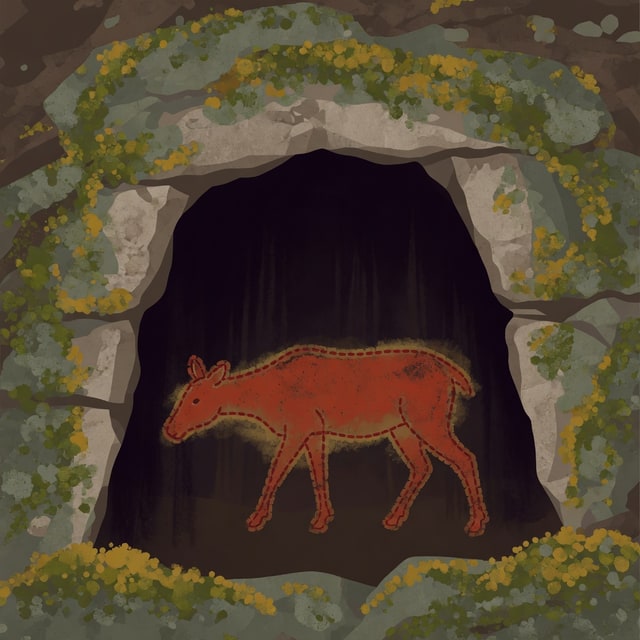
Palaeolithic cave art
The Painting Frieze
El Pendo’s Painting Frieze: a 25-metre panel of red hinds, a horse and a goat in dotted outline, found in 1997 and about 20,000 years old.
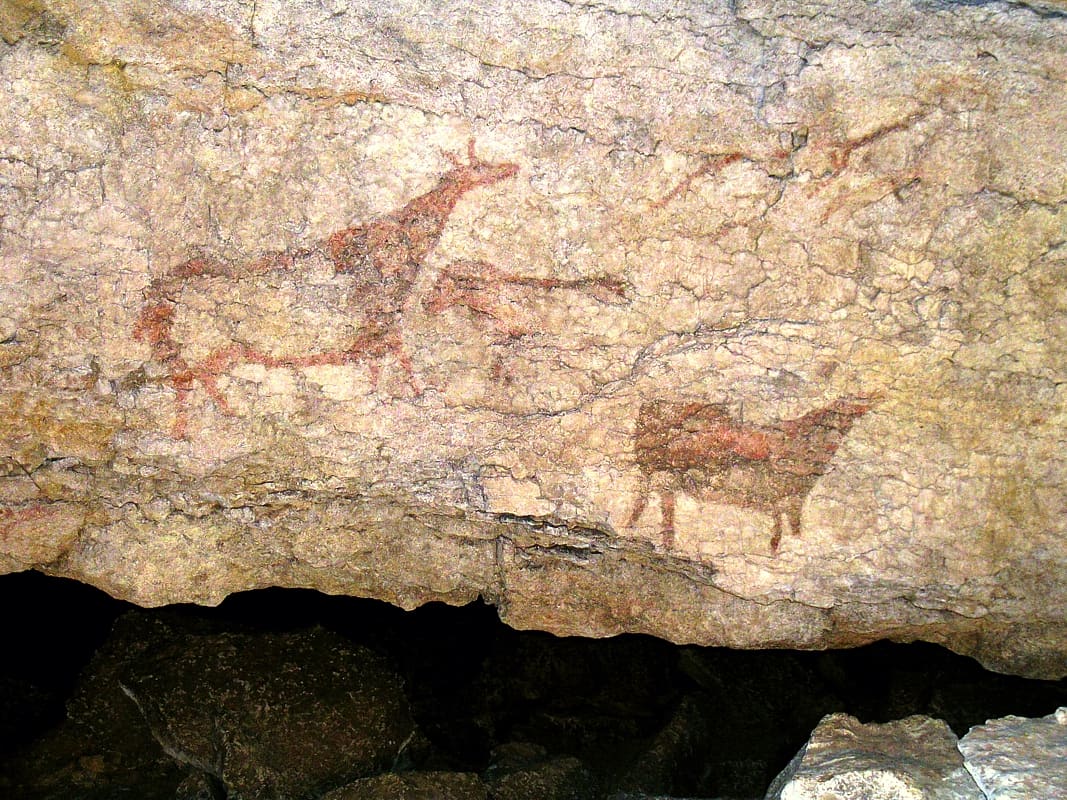
Image: Wikimedia Commons · File:EL_PENDO_low.jpg
A panel hidden by dirt
Until August 1997 only two engravings were known, found by Hermilio Alcalde del Río in 1907 at the back of the cave (at least one is a bird, perhaps a waterfowl or a great auk). Ramón Montes and Juan Sanguino then recognised a great red panel that a crust of dirt had hidden.
The Painting Frieze is a 25-metre rock face about 80 m from the entrance, in the dark zone: daylight stops a few metres short, so the figures need artificial light. Most of the 24 red paintings sit on this front; 19 of them concentrate in about nine metres.
Hinds, a horse, a goat, signs
Twelve hinds dominate, with a goat, a horse, two indefinite zoomorphs and signs — dots, discs, lines, a horseshoe. They are painted in iron oxide. The leading technique is the dotted outline, finger-drawn or stamped, as at Covalanas; some figures mix that with a linear stroke or flat wash.
Composition, technique and style point to a single campaign. The largest hind and a partly drawn horse face each other in the centre, with filled necks and heads and limbs that suggest walking, running or leaping. Artists also used natural cracks and edges of the rock as parts of the animals.
Date
Absolute dating is hard. Official texts place the frieze in an early phase around 20,000 BC. Comparisons with dotted-outline red figures from Covalanas, Arenaza, Llonín, El Castillo or La Pasiega point to a Cantabrian graphic tradition, not a Magdalenian one.
The value of the find is the spectacle of the set, what it adds to Palaeolithic cave art, and the fact that it appeared in one of south-western Europe’s essential sites.